

My MIT Sloan cohort named me “Mystery Man.” I wasn’t mysterious. I’d been managing a condition, alone, in silence. This episode names the pattern.
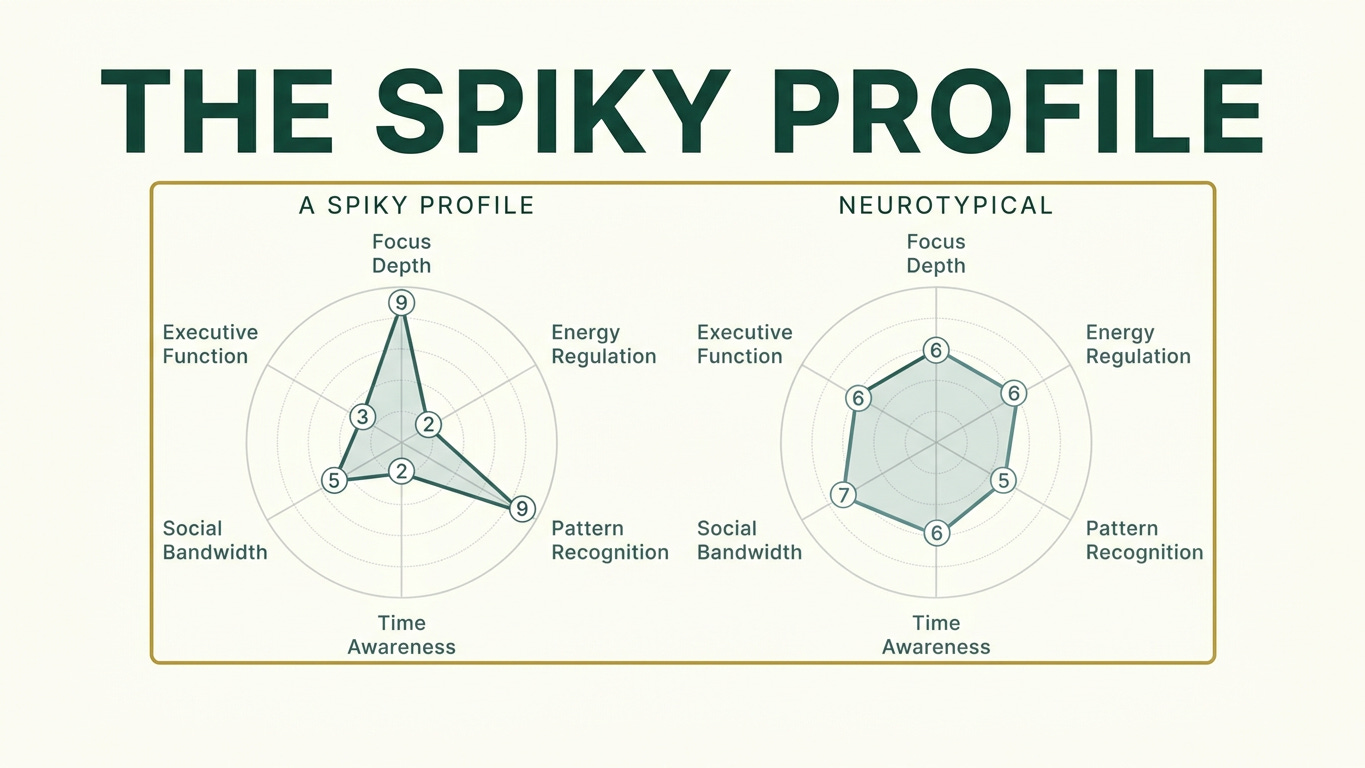
The Spiky Profile is a performance signature defined not by average ability, but by the distance between your peaks and your valleys. You may be brilliant at strategy but unable to maintain a filing system. In this first episode I put the book’s Figure 1 on screen, two radar charts side by side, and read the shape once: Focus Depth, Energy Regulation, Pattern Recognition, Time Awareness, Social Bandwidth, Executive Function.
The argument underneath is mechanical. When a car veers left, we don’t call it lazy; we fix the suspension. When people veer off course, we blame their character. Decades of behavioral research suggest this is backwards: you cannot willpower your way out of a mechanical failure.
The term comes from the neurodivergent world, but you don’t need a diagnosis to have a Spiky Profile. You just need a smartphone, a demanding job, and a life that refuses to pause while you figure it out. I tell the story of the breaking point at MIT Sloan, and the decision the whole series is built on: I stopped trying to fix my brain. I started fixing my architecture.
Chapters (each time opens the video at that point)
0:00 “Mystery Man”
0:49 Your life is a system
1:23 The Spiky Profile: Figure 1, six axes
2:23 Terrain and weather
2:39 A typical Tuesday
3:55 Two jobs at once
4:26 The breaking point at MIT Sloan
5:36 What is wrong with me?
6:19 External hardware
6:58 One thing to do today
7:17 A misaligned system
The book: The Spiky Profile: Operating Manual for High-Capability Minds That Stall, by Luis A. Salazar.
Amazon: https://www.amazon.com/gp/product/B0HCXHQ1T3
Other retailers: https://books2read.com/thespikyprofile
Free PDF, The Architect’s Field Guide: https://www.thespikyprofile.com/p/field-guides
Series: The Spiky Profile, Episode 1 of 35. Next: The Systems I Built for My Deficits Made Everyone Faster.
Watch the series in order: https://www.youtube.com/playlist?list=PLScvmew9JykM
A note on stories: as in the book, the first-person examples in this series are true in substance and may be adjusted, rounded or combined to teach the idea clearly.