

Imposter syndrome isn’t a character flaw. It’s a math problem.
Your identity isn’t something you are. It’s something your brain computes — a running average of what you’ve done lately. The Moving Average. And because recent days count for more than old ones, the number moves with your week.
Most of the time you don’t notice this. On a good stretch the average sits high, the evidence lines up, and you feel like yourself. Then comes the trough — the down stretch that comes with a Spiky Profile, where the brain won’t fire and the output column goes quiet. A few days of that and the recent data is all low, and the average drops far enough that months of real, earned evidence stop feeling true. Same record. Same person. The math just reweighted, and the verdict flipped.
That’s the part worth seeing before you try to fix it: the fraud feeling doesn’t strike at random, and it isn’t a referendum on whether you’re actually any good. It shows up in the trough, on schedule, because that’s when the recent data runs against you. The answer was never to think harder about whether you belong. It’s to see the equation you’re standing inside — and then to vote.
Maybe you know the feeling from a specific room. The promotion you earned that now feels like a clerical error someone’s about to catch. The skill you taught yourself, in front of people who paid you for it, that you suddenly can’t quite believe you have. A year of work you could list on paper, line by line, that one quiet Tuesday somehow outvotes. The strange part is never the bad week itself. It’s how completely a few flat days can overwrite a record that took years to build.
The dangerous part isn’t the trough itself. It’s what a Spiky mind does with it. Most capable people read themselves in binary — today was good or bad, the project’s working or it’s failing, I’m on track or I’ve blown it. There’s no middle register, no gray. So when the trough hits and the recent data goes quiet, the binary hands down its verdict: I’ve failed, the whole thing is broken, I’m back to zero. And then comes the worst move of all — the reset. You broke the streak, so you start over, which means you stop casting any vote at all, which drags the average down for real and manufactures the exact evidence you were afraid of. The feeling lied. And then you went and made it true.
Here’s what’s actually running underneath. Your brain is a pattern-recognition engine, and it watches you with the dispassion of an accountant. You perform a behavior; it logs the behavior as evidence; the evidence updates what it believes about you; and that belief shapes what it expects you to do next. Action, Evidence, Belief, Expectation — the loop runs whether you’re paying attention or not. Each behavior is a vote. Not a metaphor — a literal data point your brain counts. Identity is just the Moving Average of your recent votes. Write most days and the average reads writer. Show up when it’s hard and it reads resilient. The brain doesn’t ask permission before it updates the model. It just tallies.
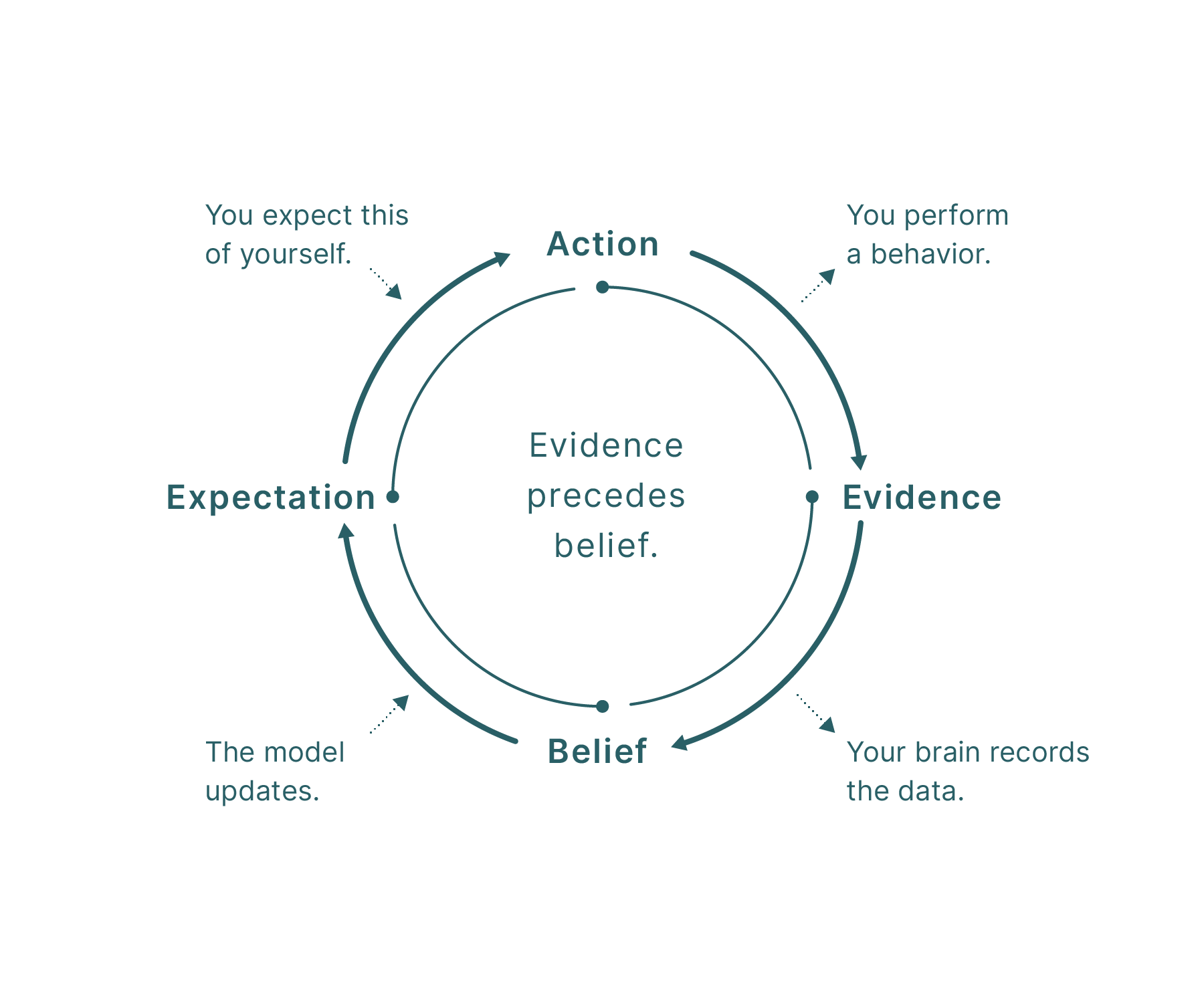
And you’re not the only one running the math. Everyone who knows you keeps their own Moving Average of you, built from the same kind of evidence — the times you delivered, the times you went quiet, weighted toward whatever you did most recently. It’s why a strong stretch can quietly change how a room treats you, and why a rough one can cost you standing you thought was already banked. You don’t get a vote on their weighting any more than you get one on your own. Which means the same fix works in both directions: you can’t announce the identity you want people to hold. You can only keep handing the evidence over until the average turns.
I learned how this actually works in the place where the votes are smallest and matter most.
I’ve been a father for years now, and almost none of it has looked like anything. I walked them around the living room when they were learning to stand. Most mornings I cut fruit and pack it into lunch bags. I’ve sat through the school presentations and the dances — the kind where you stand at the back and clap, and they find your face in the crowd and pretend they weren’t looking for it — and I show up to every parent-teacher conference to hear how the grades are going. I built the brushing-your-teeth habit one reminder at a time, the way you build any habit: by being there at the same unremarkable moment, again. And when I recognized that they carry their own Spiky Profiles — the same wiring that cost me years before I understood it — I found the specialists and got them help early, so the road I had to map alone is one they’ll get a running start on.
None of that is a moment. There’s no scene, no turning point, no single day a camera would care about. Hand any one of those mornings to a stranger and they’d see a guy cutting an apple.
But I know exactly what it is, because I know how the math works. It’s a Moving Average computing father, one ordinary vote at a time. And here’s the thing that keeps me cutting fruit on the mornings I’m wrung out and would rather not: to them, I’m not a tired guy in a kitchen. I’m the one constant they’ve had since the beginning — their one superstar, the way a kid thinks about the player who shows up every single night and scores, quietly, point by point, until the total is a number nobody can argue with. No single point looks like much going in. The total is a childhood.
The trap lives here too, by the way. Lose my temper, miss an event, phone it in on a bad day, and the binary wants to file its verdict on the spot: I’m failing them. But that’s one data point against years of votes. The bad day is real. It’s just not the average.
This is the part that changes how you operate. You don’t think your way into being a father, or a writer, or a disciplined person — and you can’t feel your way there either. You can’t trick your own operating system. Evidence comes first; belief follows the evidence. Which means the move on a trough day isn’t to summon a conviction you don’t have. It’s to cast the smallest possible vote, the one you can manage on your worst day. Five push-ups doesn’t build muscle — it keeps the identity of the athlete on the books. Driving them to school on a morning I’m running on empty doesn’t win any award. It just keeps the average from collapsing, and it tells my brain — and theirs — that this is still who I am. That’s the Minimum Viable Action: a vote sized for the trough, not the spike.
And there’s a quieter dividend in it. Every vote you cast on a bad day is a promise you kept to yourself under load, and self-respect is mostly just the track record of promises kept — which is exactly why it has to be built on promises sized for the brain you actually have, not the one you borrow on your best week.
So here’s the one move I’d run if you take nothing else from this.
Pick one identity you’re trying to become. Then define the single smallest daily vote that proves it — not your best version, your worst-trough-day version, the one you could still cast while sick, slammed, or flat. The writer’s vote might be one sentence. The athlete’s, a single set. The present parent’s, one real question at dinner. Cast it seven days straight.
The discipline is in what you don’t track. Not the outcome, not your mood, not whether you feel any different — because for the first week, you won’t. You track one thing: did the vote get cast, yes or no. Seven small yeses won’t transform you, and that isn’t what they’re for. They’re there so that when the next trough arrives and the fraud feeling shows up on schedule, the average has somewhere solid to stand.
You are the running total of what you actually do, and that total updates whether you believe in it or not — your brain keeps the books with or without your permission. So the imposter feeling isn’t a sign you’ve been found out. It’s a reading off a small recent sample, taken at the exact moment it’s least worth trusting. When it comes, don’t argue with it and don’t reset. Cast the next vote. Then let the average catch up to the truth it’s been recording all along.
The book — The Spiky Profile: Operating Manual for High-Capability Minds That Stall — publishes October 2, 2026. A new piece goes out every week.
Pre-order: amazon.com/dp/B0GX35CMSZ